Knowing the trail › Whole trail › Bog begins beyond Newport from Westport
Bog, machair and the wild life beside the trail
The greenway crosses some of the best Atlantic blanket bog left in Ireland and runs past salt marsh and sandy grassland. Here is what you are riding through, and how to see it.
Trail noteThe bog and the marsh beside the trail are soft, fragile and wetter than they look. Stay on the path, and give nesting birds plenty of room in spring and early summer.
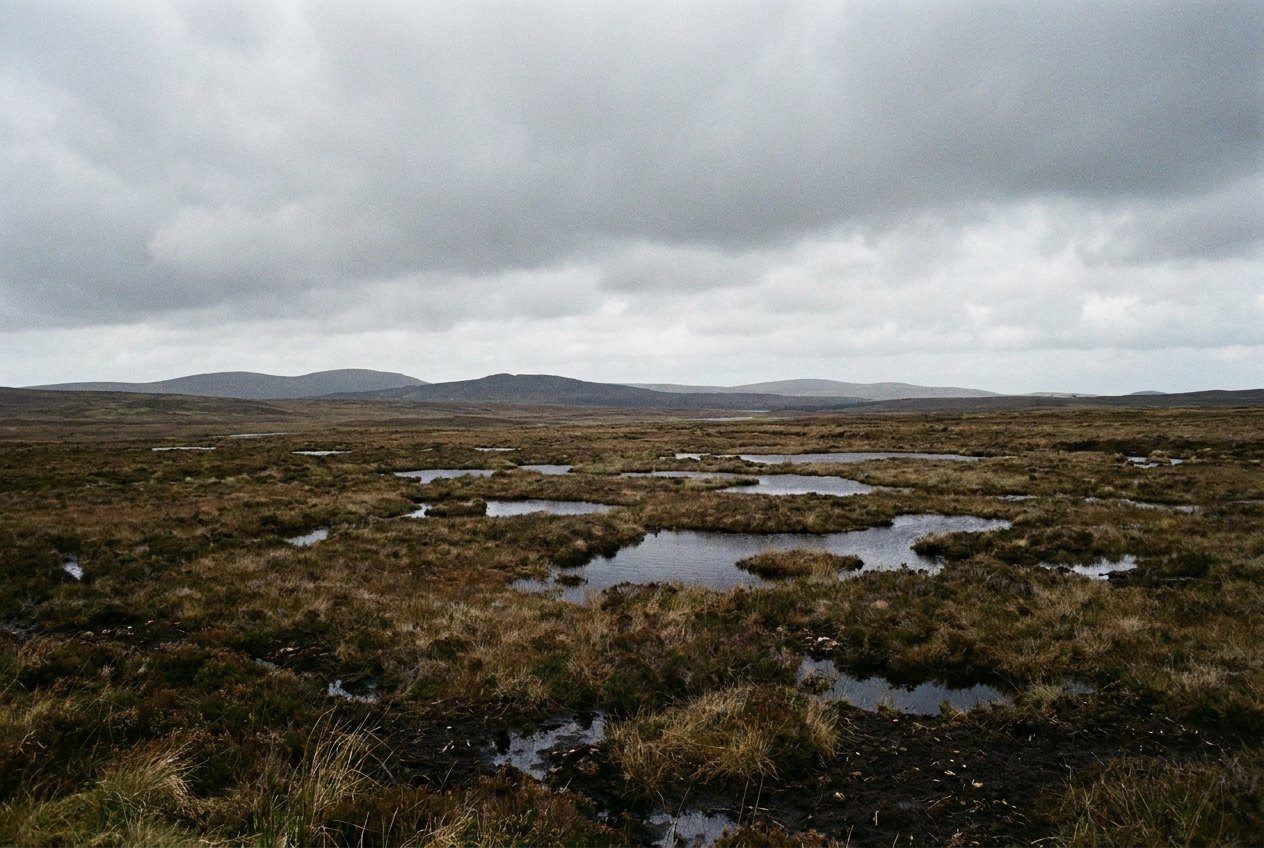
Ride or walk out of Westport and the country at first is green fields, hedges and small farms. Past Newport it changes. The fields give way to wide, open bog, brown and ochre in winter, flecked with white bog cotton in early summer and purple with heather by late summer. Further on, near Mulranny and Achill, the trail runs past salt marsh and sandy grassland by the sea. These are some of the richest and most fragile habitats in Ireland, and the greenway gives you a quiet way to see them.
Atlantic blanket bog
Blanket bog forms where rain is heavy and constant, the ground is poor and drainage is slow. Over thousands of years, mosses and other plants grow, die and fail to rot fully in the waterlogged ground, and the remains build up slowly as peat. In this part of Mayo the peat lies over the land like a blanket, covering hills and lowland alike, often several metres deep.
Ireland holds a large share of the Atlantic blanket bog left in Europe, and the bogs of west Mayo are among the finest examples. To the north of the trail, the Nephin Beg range and the bogs around it form part of a national park, Wild Nephin, with miles of open country and very few people.
What grows there
- Sphagnum moss in green, red and orange, the main peat-builder, holding many times its weight in water.
- Bog cotton, whose white tufts cover the bog in early summer.
- Heather and cross-leaved heath, turning hillsides purple in late summer.
- Bog asphodel, a small yellow star that turns orange as it fades.
- Sundews and butterworts, small plants that catch insects to make up for the poor soil.
You do not need to leave the path to see most of these. Look at the trail's edge and the drainage ditches beside it.
Turf and the bog's long story
People have cut peat, known here as turf, for fuel for generations. You will see the marks of it from the trail: straight cut banks, stacks of turf drying in summer and the occasional small shed. Turf cutting has changed a great deal over time, and on some protected bogs it is now restricted; it is a subject people here feel strongly about, so it is best approached with interest rather than opinions.
Peat also holds history. Because it preserves what falls into it, bogs across Ireland have kept old tools, timber trackways and field walls far older than the railway. Ireland's bogs also store a great deal of carbon, which is one reason they are now valued and protected.
Off the trail: Achill Island beyond the end of the trail
Salt marsh and machair
Around Mulranny the trail drops towards the sea and the habitats change. Salt marsh forms on sheltered shores where the tide floods low ground and drains away again, leaving a mat of salt-tolerant plants cut through by small creeks. In summer it is studded with pink thrift, sea lavender and samphire-like plants, and at high spring tides the water spreads right across it.
Machair is something else: a sandy grassland found behind beaches on parts of the west coast of Ireland and Scotland. Shell sand blown in from the shore sweetens the soil, and the result is a low, flowery turf thick with clover, wild thyme, orchids and other wild flowers in early summer. There is machair around parts of Achill and the Mulranny shore. It is easily damaged by vehicles and trampling, so keep to paths and tracks.
Mulranny is also known for its heathers, including a Mediterranean heath that grows in only a few places in Ireland, mostly along this coast. It flowers early, often in spring.
Birds of the bay and the bog
Clew Bay, its islands and the shore along the trail hold a wide range of birds through the year. You do not need to be an expert to enjoy them, and a pair of binoculars makes all the difference.
- On the shore and the mud: oystercatchers, curlews, redshanks and grey herons, with little egrets now a regular sight.
- In winter: flocks of brent geese and wading birds arriving from the far north.
- Over the bog: meadow pipits, skylarks and stonechats, with birds of prey such as kestrels hunting low.
- On the cliffs of Achill: choughs, red-billed crows that tumble in the wind, and seabirds offshore.
Spring and early summer are nesting time. Many birds on the bog and the marsh nest on the ground, so stay on the trail and keep dogs on a short lead. If a bird calls in alarm or circles over you, you are too close; move on.
Otters and other mammals
Otters live along this coast, in the rivers and around the shore of Clew Bay. They are shy and mostly active around dawn and dusk, so sightings are a matter of luck and patience. Watch quiet inlets and river mouths at the edges of the day, look for a low, dark head moving through the water, and keep still. Signs are easier to find than the animals: tracks on mud and droppings on rocks near the water.
Seals are seen in the bay, especially around the islands. On the bog you may see hares, and foxes cross the trail at dusk.
Seeing it well
The best way to see the wildlife beside the greenway is to slow down. Stop at a bridge over a river, sit on a wall near the shore at high tide, or walk a short stretch rather than riding it. Early mornings and evenings are best for birds and for otters. Read the stage guides to Newport to Mulranny for the bog and Mulranny to Achill for the marsh and the shore, and keep an eye on the Atlantic weather, which shapes all of it.
Next note: Seafood, mountain lamb and brown bread on the Mayo coast